KareBare
Your Personalized Social Media Companion
Try it yourself. Download now.


UI/UX
Application Design
ux research
CASE Study
Introduction
Social media is central to teenagers' lives, offering connection, expression, and entertainment through apps like Snapchat, Instagram, TikTok, Twitter, and Meta. Navigating social media effectively is an essential skill as the internet becomes more integrated into daily life. However, teens also face challenges like cyberbullying, screen addiction, and exposure to bad actors, which can negatively affect their mental health.
Past solutions, including educational and tech-based interventions, have been insufficient in offering comprehensive support. Enter KareBare: an AI chatbox designed to help young users navigate social media safely. With personalized chat interactions, screen time alerts, and resources for online risks, KareBare aims to promote a healthier, more positive digital experience.

Social media apps validate age verification to deter minors from using their platforms. However, these systems are weakly enforced and are easily avoided
Main Features
Customizable Interactive Chat Box
Unlock a world of tailored support and connection with our personalized chat box, offering customizable features to enhance your digital journey.
Screen Time Monitoring
Take control of your screen time and find balance in the digital realm with our intuitive screen monitoring tool, ensuring a healthier relationship with technology.
Education on Online Risks
Empower yourself with essential knowledge and skills to navigate online risks confidently, guided by our comprehensive educational resources and insights.


User Research
In order to understand our user problem, and their user needs, we implored literature review to determine our major stakeholders in this design space. Through literature review on the online risks and impact of social media on teenagers & young adults and government policies holding social media platforms accountable, we discovered valuable research insights on the effects of social media, such as teens struggling with mental health, harassment & cyberbullying, and screen addiction.

Literature Review
Despite previous efforts, there is still a lack of resources to help teens cope with trauma. Our design should focus on providing tools to support youth in navigating these issues. Research shows that teens face risks on social media, including harassment and exploitation, often by older users. Teens may struggle to confide in parents due to generational gaps and judgment, while schools lag in addressing these evolving risks. Although shielding teens from all explicit content is unrealistic, there is room for improved intervention.
From a policy perspective, U.S. government actions have aimed to regulate platforms like Meta and TikTok, particularly regarding harmful algorithms targeting young users. However, there are significant limitations in legal intervention, including the challenge of holding platforms, offenders, and even parents accountable. While lawmakers push for better content moderation, platforms are protected under the First Amendment and Section 230, which limits their liability for user-generated content and raises concerns about censorship.
"A number of studies have found evidence to support an association between IA (Internet addiction) and depression, loneliness, low SE (low self-esteem), and shyness."
"It is possible that in teens’ primary appraisals of an initial online risk occurrence, they did not anticipate any imminent danger and waited to engage in active and communicative coping behaviors until the risk became particularly stressful or recurred."
"Rather than focusing our efforts on trying to prevent teens from being exposed to all online risks, it may be more beneficial to teach teens more effective ways of coping with the risks they do experience"


Our Stakeholders


Target Users:
KareBare serves as a digital guardian for adolescents, offering a safe haven amidst the landscape of social media. Tailored specifically for teenagers aged 12 to 18, our platform goes beyond mere monitoring, providing a nurturing environment where young users can learn, grow, and thrive.
Survey & Studies:
Our surveys revealed that the majority of students created their first social media accounts between the ages of 12 and 15, with Snapchat or Instagram being their first.
Today, they predominantly use Instagram or Facebook, expressing concerns about social media's detrimental effects on mental health, referring to it as "toxic."
Many students indicated that implementing restrictions, such as screen time limits until a certain age, would be a reasonable approach.

Semi-Structured Interviews
From our parent interviews, there was an acknowledgment of the pros and cons of social media.
There were attempts made by the parents to educate their children on social media, also along with relying on school intervention. However, some said that the education wasn’t as incorporated in their middle school/high school years. They are also aware of the restrictions they attempt to put on their children and how some might be too harsh or not efficient enough. They also believe that they should be supervising their children and their online behaviors
"Our school district, in the beginning when social media was really growing as a platform, they tried to do parent-teacher workshops. Where the local police came in the school district would talk to parents about predators and about how predators use social media to lure children, some of the things to look for, and how to download certain parental protections on their phones."
"Being able to communicate via social media was very helpful…there was always some parents posting the band competitions when we were unable to make it, or the kids being able to send pictures or videos to see the performance in real time. It was always nice to have that and to know what was going on in real time. Same thing with sports!"
“As social media was becoming more mainstream, certain projects at school utilized them so they had to have certain apps. So it was just a matter of having to keep up that we had to start allowing more and more tech access to our kids.”
From the student interviews, one of the main insights was how the introduction of social media by parents influences their children’s online behavior. There was a cognitive dissonance between participating and fully understanding what cyberbullying is. It was also common for the students to experience peer pressure, insults, and group chats which were the main sources for any risks online.
“Snapchat was just another a way to communicate to talk to kids from school. Not everyone had iMessage or was ok with sharing their phone number so Snapchat was what everyone used”
“My mom never allowed me to have social media, but eventually I disobeyed her. On an iPhone, it is really easy to hide apps and take them off the home screen, so that's what I did.”
“Using Instagram at a young age probably is not good due to seeing so many opinions about other people. I actually got bullied when I was in middle school”
Our Design Problem
Young users need help learning social media literacy because knowing how to navigate online interactions is crucial for their personal development, but lack a proper support system to deal with online harms such as harassment, cyberbullying, and avoiding bad actors
Our Design Goal
By instilling essential digital literacy skills and promoting responsible online behavior, KareBare empowers teenagers to navigate the complexities of social media with confidence and integrity. Whether it's combating bad actors, managing screen time, or fostering positive self-image, KareBare is their trusted companion.
How Might We: Help young users cope with their negative feelings caused by social media?
A: An interactive chat box that users can use to vent about their experiences, and check-in on their wellbeing!
How Might We: Assist young users in reporting bad actors and avoid future encounters with them?
A: A report system that automatically flags bad actors' accounts across social media platforms
How Might We: Motivate young users to spend time offline away from their phones?
A: Interactive screen time monitoring with recommendations from the A.I. about their hobbies and interests!
How Might We: Help parents start important conversations about social media with their kids?
A: A private report log to help parents keep in touch with their child's online behavior
KareBare UI
-
Friendly Mascot Appeal: Utilizing pandas as a cute and approachable mascot can make the AI more inviting and less intimidating for young users, fostering a sense of comfort and trust.
-
Character-Based Interaction: Incorporating a character adds personality to interactions, creating a more engaging and personalized experience that strengthens the user-AI relationship.
-
Color Psychology: Thoughtful color choices and a minimalist design reduce cognitive overload, enhancing user-friendliness and allowing for personalization, empowering users and improving their overall experience.
-
Youthful Aesthetics: Embracing modern, clean designs aligns with the preferences of younger users, ensuring relevance and resonance with contemporary design trends popular on social media platforms
-
Focus on Content: Minimalistic design directs attention to educational content on social media literacy, ensuring that important information remains prominent during interactions with the AI.
-
Visual Clarity: Simple design facilitates easy navigation, catering to younger users who prioritize streamlined interfaces for seamless interaction experiences.


Onboarding


Our KareBare A.I. acts as an app extension for both IOS and Android devices. This login helps customize the chatbox for the user’s preference. This personalization helps the user to be interested in engaging with KareBare.
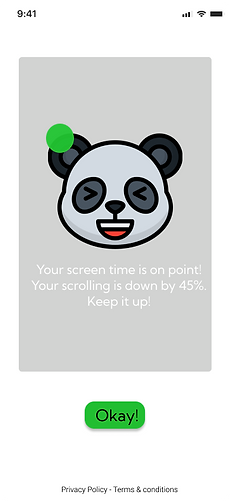
Screentime
KareBare sends personalized screen time reminders to users, encouraging them to take breaks and maintain a healthy balance between online and offline activities. These reminders are tailored to individual usage patterns, incite convos based on past texts, and recommend hobbies or activities delivered in a friendly and supportive tone.


Chatting with Kare


Saw a supermodel story on Instagram that made you feel insecure? Talk with KareBare about how you feel. Using past conversations, KareBare develops empathetic responses and curates helpful info to cater to the user’s needs for their mental health.
Parent Log


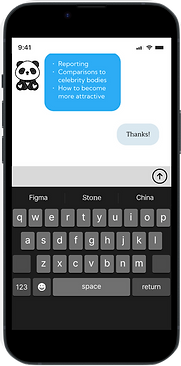
Our app incorporates a Parent Log feature, providing invaluable insights into children's online activities and well-being. By offering weekly reports on screen time, social media interactions, and potential instances of harassment or cyberbullying, parents can stay informed and initiate crucial conversations with their children about responsible digital behavior. This feature not only promotes open dialogue but also enhances child safety by empowering parents to take proactive measures.
Bad Actors
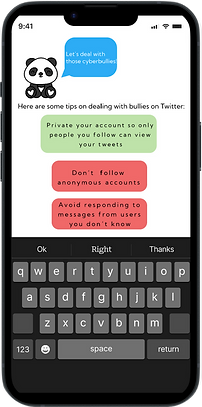
Young users are under immense stress facing anonymous dangers across different social media platforms. Facing cyberbullies, groomers, and harmful posts due to trolls. Get immediate help when facing a bad actor with KareBare. Provide a link to the post and our chatbox will recommend the best strategies to deal with these encounters.
Evaluation
We evaluated our design with the participation of 2 experts in A.I. Research and 4 freshman college students as end users. We asked our participants to navigate the prototype without guidance and wanted to see:
-
Can our users successfully use Kare Bare when it gives a notification?
-
Is Kare Bare effective as an interactive chat box?
-
Are the users satisfied with Kare Bare’s prompts? Do the users feel motivated to keep chatting with Kare Bare or do they want to go back to using social media?
Major Takeaways
We set up user scenarios to illustrate the major use cases by forming video simulations for our participants:

KareBare felt very supportive and nonjudgmental when helping with bad actors
The answers & resources provided by KareBare felt authentic and practical
Customizing KareBare is very easy to use and update

More proactive check-ins from KareBare needed -- conversations with the A.I. felt too stiff
KareBare felt very supportive and nonjudgmental when helping with bad actors
Direct messages between the teen and chatbox should be private from the parents to build trust.
Screen time alert messages were not clear to users
Building Trust with Teens: Parents
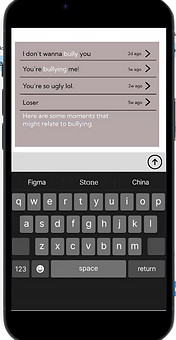
Direct Messages <<< Abridged Report on the Topic
Based on feedback from our evaluators, parents should not be able to view the exact text record between their kids & KareBare


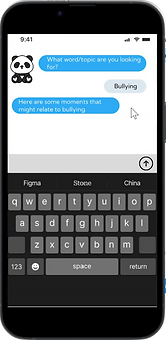
Building Trust with Teens: Chat Box
Make KareBare more proactive in checking with the user
We incorrectly assumed the chat box can only interact when the user wants to interact with its features. By including opportunities for KareBare to initiate conversations, it helps build a positive relationship to become more trustworthy, encourage user to seek its advice, and better intervention during screen time/crisis situations.
.png)



Screen Time Notification
Based on feedback from both our evaluators and end users, the signifier for screen time notifications was too easy to miss. We changed the icon for the KareBare chat box to make it more accessible.



The Team
Anthony L. Vincent D. Valerie B.
Cornell University
INFO 4420 HCI DESIGN
-----------------------------------------------------------------------
Future Developments
KareBare has become a more comprehensive virtual mentor encouraging users to be mindful online, avoid screen time addiction, and provide effective coping strategies against online harms. While our current design is more effective at addressing our target audience needs, there is still major room for improvement:
-
Aiming to advance its AI capabilities to enhance user experience with proper integration with popular social media platforms without utilizing predatory practices to encourage user engagement
-
Advance KareBare to understand and respond to current slang and evolving forms of online harassment. By staying updated with the latest trends in social media interactions, the KareBare AI can better assist young users in navigating these complexities, providing more relevant and timely guidance
-
Expanding its resources for dealing with online harassment and maintaining a positive self-image. This includes developing more comprehensive strategies for responding to cyberbullying and providing support for users experiencing negative interactions online
-
Expanding its features to include more personalized interventions, such as tailored self-care suggestions, extreme cases such as suicide prevention and self-harm consoling, and real-time monitoring of online interactions, to further enhance users' well-being and safety in the digital world

In conclusion, our journey through INFO 4420 HCI Design has been both enlightening and transformative. Through intensive research, iterative design processes, and hands-on prototyping, we've not only gained valuable insights into designing a product also honed our skills in crafting digital solutions that resonate with today’s needs. We can continue to design for impact in the near future.